Key takeaways
- At Meant, a bespoke Next.js website, bilingual or not, starts at $4,000 and runs to $35,000, depending on pages, features and design complexity. Arabic does not add a separate surcharge on top of that range: it's priced inside it.
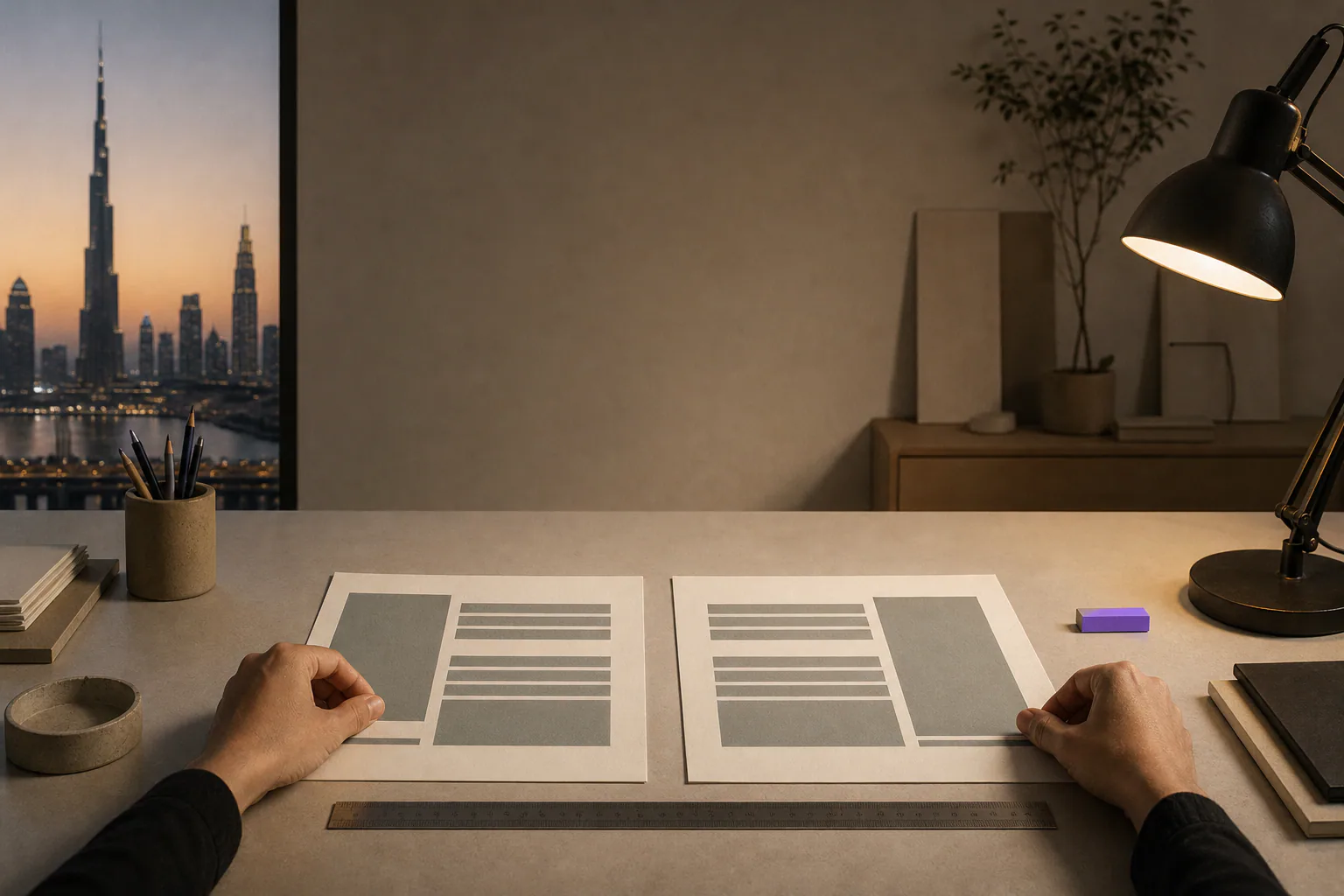
- Arabic reads right to left and has its own typography and line lengths. A genuine bilingual build designs two layouts, not one layout with flipped text.
- Saruest's bilingual Next.js site treats Arabic as a first-class layout rather than a mirrored afterthought. The same site carries a home-and-business savings calculator and a hand-drawn footprint map.
- A fixed-price quote for a bilingual build should state, in writing, which pages get full EN/AR parity and which get summary translations only.
- A bilingual site costs more to maintain than a single-language one, because every content update happens twice.
Bilingual Website Design Cost: What an EN/AR Build Actually Runs
At Meant, the bilingual website design cost for a custom Next.js build sits in the same range as any other site we make: $4,000 to $35,000. Arabic does not sit on top as a flat surcharge. Where your project lands depends on how many pages it has, what they need to do, and how complex the design is. A focused bilingual landing page or a small marketing site sits towards the lower end. A large content site, a product with interactive tools, or a full storefront in two languages sits higher.
The extra cost depends on what the second language touches. A five-page brochure site with full Arabic parity needs a second set of layouts and a round of right-to-left testing. Add a calculator, a booking flow, three forms and a blog, and each of those has to behave correctly in both directions. That's where the hours go.
Our page on bespoke website design and development covers the core build. This article covers what Arabic adds to it, and how to check that a quote has priced that properly.
Why Arabic Isn't a Translated Copy of the English Site
Arabic is among the five most spoken languages in the world. Yet according to W3Techs data it accounts for just 0.6% of websites with an identifiable content language, against 6% each for Spanish and German. That gap goes some way to explaining why so few sites get right-to-left design right. Not many teams have had the practice.
The extra cost of an Arabic English website build sits in three places.
Right-to-left layout, not a mirrored flip
Arabic reads from right to left, so the whole page reads that way. Navigation starts on the right. Progress moves leftward. Back arrows point the other way.
Not everything flips, though. Logos stay as they are. A video play button still points right, because it means "play", not "forward". Phone numbers, prices in Latin digits and embedded English product names still run left to right inside an Arabic sentence. Developers call this bidirectional text. A mirrored stylesheet gets most of it wrong. Doing it properly means deciding, component by component, what mirrors and what doesn't. We do that in design, not in a fix-up pass after launch.
Arabic typography and line length
Arabic script is joined. Letters change shape depending on where they fall in a word, and many Arabic fonts carry tall ascenders, deep descenders and diacritic marks above and below the line. Set at the same size and line height as the English type, an Arabic typeface usually looks cramped and reads badly.
Arabic needs its own type scale, its own line spacing, and a typeface pairing chosen to sit well next to the English one. Translated text also runs to different lengths. A heading that fits on one line in English may wrap in Arabic, or the reverse. Buttons, cards and menus have to flex to the content, not the other way round.
Content parity: dates, numbers and forms
Then there is the detail that only shows up once a real Arabic reader uses the site:
- Numerals. Western digits (1, 2, 3) or Eastern Arabic digits (١, ٢, ٣). Choose one and apply it everywhere, including in charts and calculators.
- Dates. Format, order and calendar all need a decision.
- Forms. Labels, placeholders, error messages and validation all need Arabic versions. Email and phone fields stay left to right inside a right-to-left form.
- Search and SEO. Arabic pages need their own URLs, metadata and language tags, so search engines serve the right version to the right reader.
None of this is difficult. All of it takes time, and the time is where the EN/AR website cost comes from.
What Pushes a Bilingual Build Price Up or Down
Use these factors to place your own project inside the $4,000 to $35,000 range before you talk to anyone.
Page count and content volume
More pages means more layouts to design, build and test twice. Content volume matters as much as page count. A ten-page site with a fifty-article blog is a far bigger bilingual website development job than a ten-page site with no blog, because every article needs its Arabic twin.
Design system and components
A design system is the set of reusable parts a site is built from: headers, cards, buttons, forms. Each component needs a right-to-left version. A site built from a dozen well-made components costs less to make bilingual than one with forty one-off sections. Interactive components cost the most: calculators, maps, filters and anything with animation that moves in a direction.
E-commerce vs a marketing site
A marketing site is mostly content. A storefront adds a product catalogue, filters, a cart, checkout messages, order emails and policies, all of which need Arabic. We also build headless storefronts, where a custom front end sits in front of Shopify and checkout stays in Shopify. A bilingual catalogue on top of that adds translation and testing for every product and policy page.
| Factor | Towards the lower end | Towards the higher end |
|---|---|---|
| Page count | A handful of pages | Dozens of pages plus a blog |
| Arabic parity | Full parity on key pages, summaries elsewhere | Full parity on every page |
| Copy | You supply final copy in both languages | We write or adapt copy in both |
| Components | Standard content sections | Calculators, maps, filters, booking flows |
| Type of site | Landing page or marketing site | Storefront with a bilingual catalogue |
| Integrations | A contact form | CRM, WhatsApp and payment flows in both languages |
The bilingual website design cost moves with every row. Two rows decide most of it: parity and components.
What Should Be Included in a Fixed Bilingual Quote
A fixed price only protects you if the scope behind it is specific. This is how we quote a fixed price after a free call: scope in writing, then the number. For a bilingual build, check the scope for the following.
Design, build and translation handling
- Separate Arabic layouts for every page template, not just a note that the site "supports RTL".
- A named Arabic typeface and its type scale.
- A page-by-page list showing full EN/AR parity or summary translation.
- Who supplies the Arabic copy, and in what form. Human Arabic translation runs roughly $0.08 to $0.23 per word, similar to French or German. That rate is the smallest part of the bill. The design and build work around it is the larger part.
- The numeral and date conventions the site will use.
- Language switching, Arabic URLs and language tags for search engines.
Testing both directions, not just one
The quote should say that every page, form and interactive component gets tested in Arabic, on mobile and desktop. Plenty of sites look fine in English and break quietly in Arabic, because nobody on the team reads it. Ask who checks the Arabic and whether they read it natively.
What's usually scoped separately
Some work sits outside a standard build. Make sure the quote says where it stands:
- Ongoing translation of new content after launch.
- Certified translation for legal or regulatory pages, which adds 20% to 30% over the base rate. Rush turnaround carries a further 25% surcharge.
- Arabic keyword research and SEO beyond the technical setup.
- Arabic ad campaigns and landing page variants.
- Photography and film.
Bilingual Build vs Translated Template: Where the Money Goes
The cheap route is a template site with a translation plugin. It looks like a saving, and on the invoice it is one.
What a translation plugin actually does
A plugin swaps strings of text. It finds the English words on the page and puts Arabic in their place, either from a translator or from machine translation. Some plugins also set the page direction to right to left. What a plugin cannot do is redesign the page. The layout, the type scale, the spacing and the component behaviour all stay as they were built: for English.
Where it breaks for Arabic readers
- The Arabic font falls back to a system default, set at English sizes.
- Icons and arrows point the wrong way, or every icon flips, including the ones that shouldn't.
- Headings wrap awkwardly and buttons truncate.
- Forms show Arabic labels with English error messages.
- Machine-translated copy reads as machine-translated to a native speaker.
An Arabic reader notices within seconds. For a business selling to Arabic speakers, that first impression is the whole point of having the second language. A proper Arabic English website build costs more because it designs for that reader from the start. The plugin saves money and spends the credibility.
How Saruest Built Arabic as a First-Class Layout
Saruest's bilingual Next.js site is a working example. Saruest is a Sudan-based solar and energy company. Its family trading house, Fast International, has been importing and delivering across Sudan since 1982, and none of that history was online.
Meant built the brand and the website together: the Irradiance Peak mark, then a bilingual Next.js site where Arabic is a first-class layout rather than a mirrored afterthought. The site has a home-and-business savings calculator, a hand-drawn footprint map on real geography and real photography. It is live at saruest-ltd.com.
How to Budget for Your Own Bilingual Website
Do these three things before you brief anyone. They will make every quote you get easier to compare.
List which pages genuinely need both languages
Not every page needs full parity. Your home page, service or product pages, pricing and contact page probably do. An archive of old news posts may not. Mark each page as full parity, summary or English only. This one list has more effect on your EN/AR website cost than any other decision.
Decide RTL design before you brief a developer
Decide whether Arabic gets its own designed layouts or a lighter adaptation of the English design, and say so in the brief. If you leave it open, you will get quotes that look similar and describe very different work.
Ask for the bilingual work as a line item, not a footnote
Ask each studio to show the bilingual work separately: Arabic layouts, translation handling, RTL testing. If it appears as one line saying "Arabic version included", ask what that covers. Then budget for upkeep. A 25,000-word site where 10% of the content changes each quarter needs $700 to $1,800 of translation every quarter per language.
If you're hiring from outside the UAE, it is worth reading how a remote project with a Dubai studio runs before the first call. Most of our clients are overseas, and we hold calls in your time zone.
If you're weighing up a bilingual EN/AR build, book the free 30-minute call with Meant and we'll tell you where your quote should land.
Frequently asked questions
Is translation included in a bilingual website quote?
It should be stated either way, never assumed. We work in English and Arabic, so Arabic copywriting can be scoped into the build, or we can take final copy from your own translator. The written scope says which, and for which pages.
Do I need separate SEO for the Arabic version of my site?
Yes. Arabic pages need their own URLs, titles, descriptions and language tags so search engines show the right version. Arabic speakers also search with their own phrasing, so translated English keywords are a weak starting point. Our SEO work can be scoped to cover the Arabic version alongside the English one.
How long does a bilingual EN/AR website take to build?
It varies with scope and copy readiness: a focused landing page with two layouts and ready-to-use Arabic copy moves quickly, while a large content site with full parity across every page, interactive components and a blog takes much longer. We put the schedule in the written scope after the first call, once we can see your page list and how much Arabic and English copy already exists.
Can I add Arabic to an existing English-only site later?
You can. For an existing website of moderate size, adding a second language typically takes four to eight weeks, depending on how the site was built. If it already has direction-aware styling, adding Arabic is mostly design and content work. If not, every component may need reworking, and at that point a rebuild can be the cheaper option. We will tell you which applies before quoting.
Does a bilingual website cost more to maintain month to month?
Yes. Every new page, product or update needs an Arabic version and a check that it displays correctly. Across a larger site, ongoing translation alone can add up quickly. Budget for it from the start rather than letting the Arabic version fall behind.