A headless Shopify build is not a redesign. It is a decision to keep Shopify for what it does best, checkout, payments, inventory and the admin your team already knows, and to replace the theme with a storefront built as software. Done well, it is the difference between a store that looks like a thousand others and one designed around one product and one customer, with speed controlled to the kilobyte. Done badly, it is a slow, expensive way to lose the apps you relied on.
So the agency matters more than usual. Here are the twelve questions we would ask if we were on the buying side, with what a good answer sounds like and what a bad one hides.
1. Which of your headless stores can I use right now?
Not screenshots, not a deck. Live URLs, with the agency's name in the footer. Open each on a phone on mobile data, add a product to the basket, reach checkout. A studio that has shipped headless will have two or three it is proud of and will happily name the client. A studio that has not will show you theme work and talk about "the same principles".
2. What happens to my apps?
This is the question that catches people out. Many Shopify apps work by injecting code into the theme. In a headless storefront there is no theme, so reviews, loyalty, subscriptions, upsells and size guides each need to be rebuilt against the app's API or replaced. Ask for a list of the apps you use today, and for each one: keeps working, needs an integration, or has to go. A good agency asks for that list before it quotes.
3. Do we keep the Shopify admin and checkout?
The answer should be an unqualified yes. Products, orders, discounts, inventory and checkout stay in Shopify; the storefront reads from it through the Storefront API. If someone proposes moving checkout off Shopify, or building a "custom admin", you are being sold a different, riskier project.
4. Next.js or Hydrogen, and why?
Both are legitimate. Hydrogen is Shopify's own framework and keeps everything inside the Shopify world. Next.js on Vercel gives server rendering, image optimisation and room for the non-commerce parts of a brand: editorial pages, a blog, automations, a B2B portal on the same site. What you want is a reason, specific to your store, rather than a default. We build in Next.js and will say in an audit when Hydrogen is the better fit.
5. What will my Core Web Vitals be, and will you commit to them?
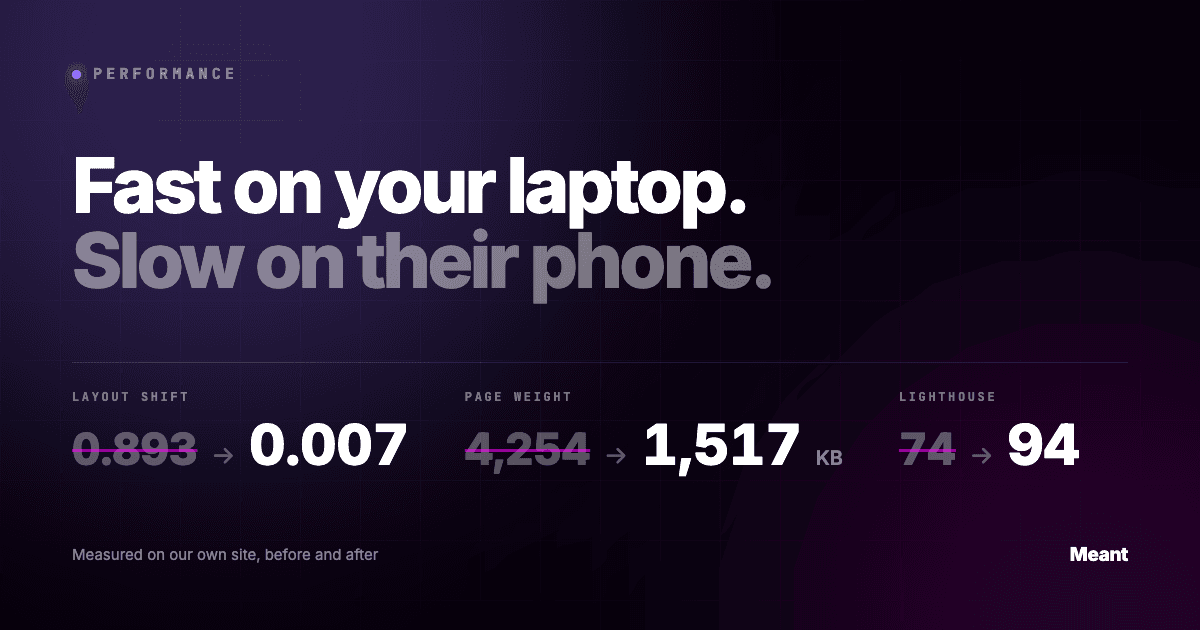
Speed is the whole point of going headless, so ask for the target in numbers: Largest Contentful Paint under 2.5 seconds on a mid-range phone, no layout shift, an interaction delay you cannot feel. Then ask which of their live stores currently meets it. Anyone can promise fast; the field data on their existing work is the proof.
6. How do you handle the migration and the redirects?
Every product, collection and blog URL you have today has search equity and links pointing at it. The plan should include a full URL map, one-to-one redirects, and a check that Google sees the new pages within days of launch. A launch that loses three months of organic sales because nobody mapped the old URLs is a common, avoidable failure.
7. How does my team edit content without a developer?
Themes come with a visual editor. Headless does not, unless the agency builds one or connects a content system. Ask to see how a merchandiser changes a homepage banner, reorders a collection or writes a landing page for a campaign. If the answer is "send it to us", budget for that forever.
8. Who owns the code, the accounts and the design files?
You should. The repository in your name, the hosting and analytics accounts opened by you with the agency as a collaborator, the design files handed over. Ask what happens if you leave in a year; a good agency has a written handover as part of the standard scope, because it has nothing to lose from you being free to go.
9. What is in the price, and what is not?
A fixed price for a written scope is the healthy shape of a build like this. Hourly billing on a headless project rewards the wrong things. Read the scope for what is missing rather than what is there: content migration, photography, integrations, a staging environment, the launch checklist, a support window after go-live. Ask how change requests are priced before the first one happens.
10. What do the first thirty days after launch look like?
Real users find what testing did not. A studio that has done this will have a named window after launch, with someone watching the analytics, the error logs and the checkout funnel, and will tell you what it fixed on the last store it shipped. Silence after launch is the most expensive part of a cheap quote.
11. Who is going to bring the customers?
A faster, better storefront converts more of the traffic it gets. It does not create traffic. Ask whether the same team can run search and paid acquisition against the store it built, or whether you will be hiring a second agency and introducing the two. When the people who built the product pages are the people running the Google Shopping campaigns, the landing pages and the tracking are right from day one. Our own case for this is Oleum Crete, whose monthly sales grew eighteen times on the storefront we built, before a dirham was spent on ads.
12. Will I be talking to the people doing the work?
Ask who is on the call, and who will be on the calls after you sign. An account layer between you and the engineer is where detail goes to die on a headless project. Small senior teams, where the person who scoped it builds it, are slower to say yes and faster to finish.
What the answers add up to
The pattern in the good answers is specificity: named stores, a list of your apps, a number for speed, a URL map, a handover. The pattern in the bad ones is reassurance. Headless is a decision you make once and live with for years, so make the agency earn it with evidence rather than confidence.
If you want a second opinion on a quote you already have, or a scoped proposal for your store, the first call is free and the written point of view that follows it is yours whether or not we work together.