In the UAE, WhatsApp is where business happens: enquiries, quotes, bookings, "is it in stock", "where is my order". Automating it is the highest-return automation most companies can buy, and also the one most often oversold. This is the honest scope, from a studio that builds these on the official WhatsApp Business API and tells clients what to leave to a person.
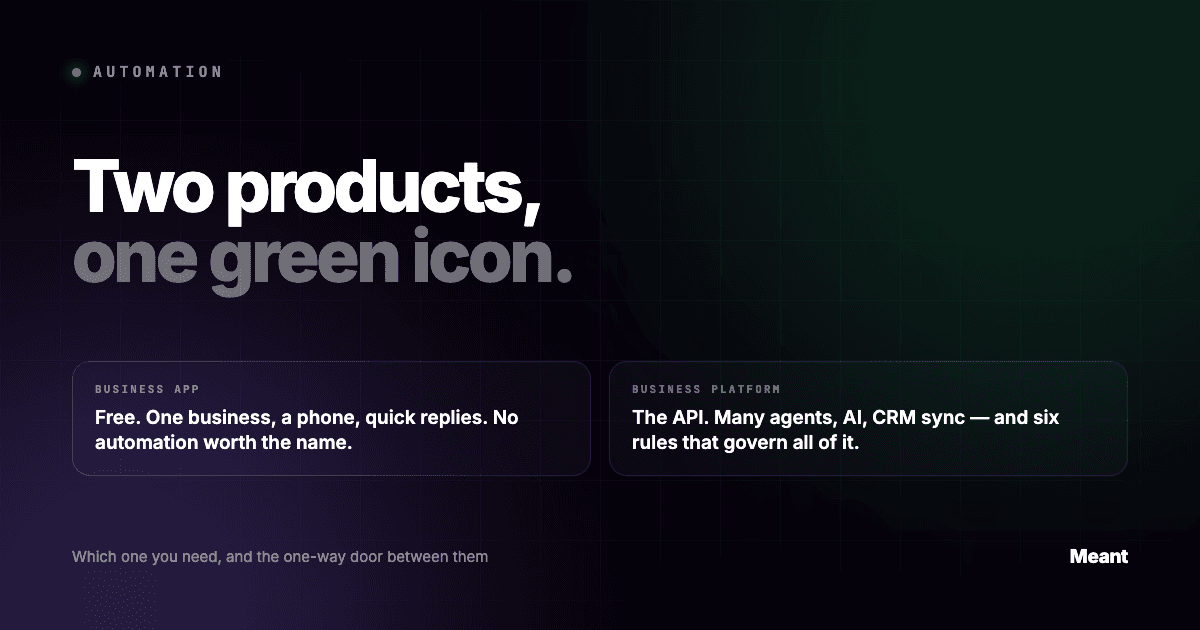
If you are still deciding between the free WhatsApp Business app and the API, read that comparison first. This piece assumes the API, because nothing below is possible without it.
What a WhatsApp agent does well
- Answers from knowledge you approve. Opening hours, delivery areas, prices, policies, product details, the fifty questions your team answers every day. The agent answers only from what you gave it, asks rather than guesses, and hands over when it is outside its scope.
- Qualifies an enquiry. What are you looking for, for when, what budget, which area. The answers land in your CRM as a lead with the fields filled in, instead of a chat somebody has to read.
- Books. Offers real slots from your calendar, confirms, reminds, reschedules. For clinics, salons, showrooms, consultancies and anyone who sells time, this alone pays for the build.
- Tells a customer where their order is. Connected to Shopify or your order system, it answers "where is my order" with the real status and tracking link, which is most of a DTC brand's support volume.
- Sends the messages you are allowed to send. Order confirmations, delivery updates, appointment reminders, payment links, abandoned-basket nudges to people who opted in, and re-engagement to past customers who agreed to hear from you.
- Hands over cleanly. A person takes the conversation in the same thread with the full context, and the agent steps back. You see every conversation.
What it cannot do, or should not
- Message people who did not opt in. Meta requires consent for business-initiated messages and blocks numbers that ignore it. A WhatsApp agent is not a cold-outreach tool, and anyone selling it as one is selling you a banned number.
- Answer what it was not told. An agent that improvises is a liability. Ours are built to say "let me get a person" rather than invent a delivery date.
- Close complex sales alone. It can qualify and book the call; the call is still yours. Treat it as the best receptionist you have had, not as a salesperson.
- Keep your chat history if the number moves. Moving a number from the WhatsApp Business app onto the API removes it from the app, and the history does not travel. This is the decision to make first, with someone who has done it.
- Replace the person entirely. The measure of a good deployment is that the human handles fewer, better conversations, not none.
What it costs: three layers
Meta's messaging fees. Conversations a customer starts are free to answer inside a 24-hour window. Messages you initiate use approved templates and are billed by Meta per message, at rates that depend on the category (marketing, utility, authentication) and the country. For a business that mostly answers inbound enquiries, this layer is small; for one that sends marketing broadcasts, it is the budget line to watch.
The platform. The API is accessed through a provider and, usually, a conversation platform that gives your team an inbox, assignment and reporting. Monthly fees vary by seats and volume. We choose it with you; we do not resell one.
The build. Designing the conversation flows, writing and testing the knowledge, connecting the CRM, calendar or store, getting templates approved, migrating the number, training the team. At Meant this is a fixed price after a short audit; projects start at $2,000, and a first flow with lead qualification and CRM sync typically ships in two to three weeks. After launch, most clients keep a monthly retainer for tuning and new flows, which can stop any month.
What to have ready
- The number decision: migrate the existing one, or run a separate automation number.
- Consent: where and how customers opt in, on the site, at checkout, in store.
- The knowledge: your real FAQs, policies and prices, in writing, owned by one person.
- The systems: which CRM, which calendar, which store, and a login for each.
- The handover rule: who gets the conversation when the agent steps back, and within how long.
How to judge a proposal
Ask three things. Is it on the official API, with your own number and your own Meta business account? What exactly happens when the agent does not know, and can you see the transcripts? And who owns the templates, the flows and the platform account when you leave? If any answer is vague, the automation will be too.
The first call is free, and the written point of view that follows will say which of your conversations are worth automating first, and which should stay human.