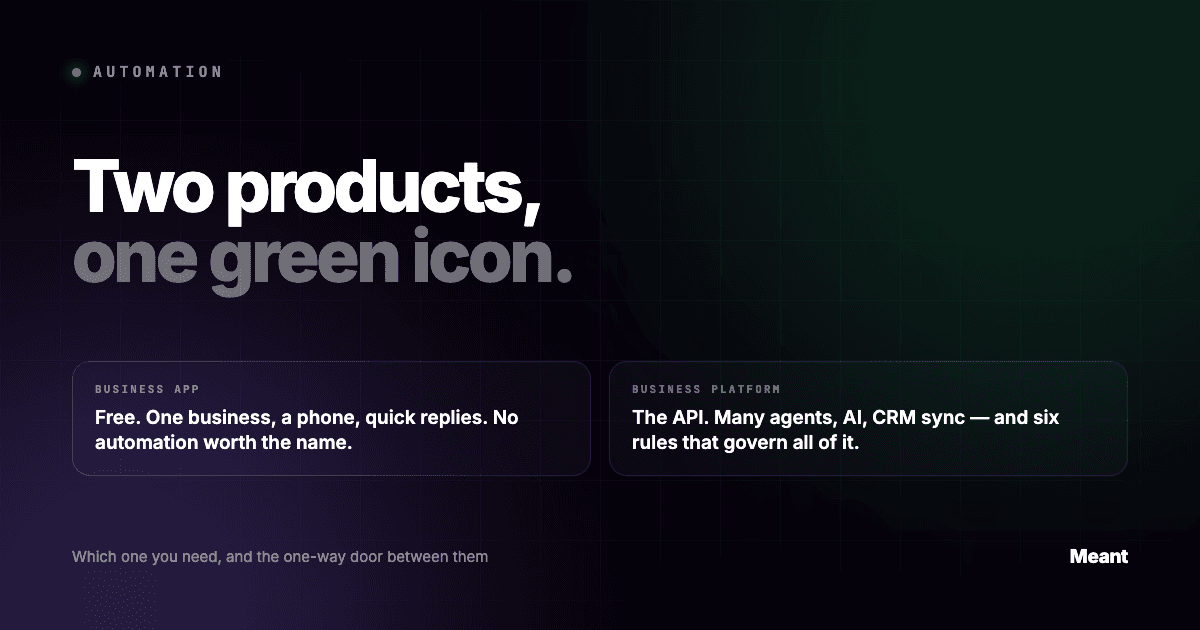
There are two WhatsApp products for businesses and they share a name, a colour and an icon. One is a free app you install on a phone. The other is a platform you connect software to. Almost every conversation we have about WhatsApp automation starts with someone who has the first and is being quoted for the second, or who has just moved to the second and lost something they did not expect to lose.
This is what each one is, how to tell which you need, and the one decision in the middle that you only get to make once.
The WhatsApp Business app
Free, from the app store, and genuinely good at what it is for. You get a business profile with your address and hours, a catalogue, labels to sort chats, away messages, a greeting message and canned replies you trigger by typing a shortcut.
What it is not is automation. The greeting and away messages are the same text to everyone regardless of what they asked. The quick replies still need a person to choose and send them. There is no way to look up an order, check a calendar, take a payment or write anything into your CRM. And it is fundamentally a phone app: the number lives on a device, and while companion devices help, it was never designed for six people working one inbox.
The app is the right answer when one or two people handle the messages, the volume is tens a day rather than hundreds, and nothing you reply with needs to know anything your colleague has not already told you.
The WhatsApp Business Platform
The API. No app — you connect it to software, either your own or a provider's, and from that point the number is addressable by code. That is what makes the difference:
- Many people can work the same number at once, with assignment and visible ownership of a conversation.
- Replies can be generated rather than typed, in the language the customer opened with.
- The conversation can reach your actual systems — calendar, catalogue, payment gateway, CRM — and act on what it finds there.
- What happened can be written back somewhere, so the inbox stops being where information goes to die.
- You can message people first, within rules, instead of only ever replying.
It is not free, and it is not instant to set up, and it comes with rules that catch people out. Those rules are worth understanding before you brief anyone.
The six rules that govern everything
1. The 24-hour window
When a customer messages you, a window opens. Inside it you can reply as freely and as often as you like, in any wording. When it closes, you can only reach that person with a message Meta approved in advance. Nearly every "why can we not just send that?" in a WhatsApp project is this rule.
2. Templates are approved before sending, not after
Anything outside the window is a template. You submit it under a category — marketing, utility or authentication — and it is reviewed before it can go out. Review is usually quick. Rejections are usually a promotional sentence smuggled into a utility template. The practical lesson is to get your templates approved early and keep a spare for the case you have not thought of.
3. You are billed per message, by category and country
Business-initiated messages cost money, and the rate depends on the template category and where the recipient is. Meta has revised this model more than once, including which messages are free, so treat any specific figure you read online — including one written today — as needing checking against current documentation for your countries.
4. Opt-in is not a formality
You need a record of how each person agreed to be messaged, and where that consent came from affects what you may send them. It is far cheaper to get this right at the start than to untangle a template rejection or a rising block rate later. Block rate matters more than people expect: it feeds a quality rating that can limit how many people you are allowed to message at all.
5. The green tick is a separate application
A verified business name is not the same thing as API access, and you do not need one to automate. They are two processes on two timelines. Conflating them is the main reason people believe the API takes months.
6. Moving your number is a one-way door
This is the one that hurts. Putting your existing number on the API takes it out of the WhatsApp Business app, and the chat history in that app does not come with it. If your number is on your signage, your invoices and three years of Google results, that is usually still the right call — but it is a decision to make deliberately, with an export taken first, not something to discover on a Tuesday.
Sometimes the better answer is a new number for automation with the old one left alone, particularly if a real person has built relationships in those threads.
So which one?
A short version.
| Business app | Business Platform (API) | |
|---|---|---|
| Cost | Free | Per message, plus whatever you build on it |
| People on one number | One, plus companion devices | As many as you need |
| Automated replies | Greeting and away text only | Anything you can express in software |
| Knows your systems | No | Yes — calendar, catalogue, payments, CRM |
| Writes back to your CRM | No | Yes |
| Good for | One or two people, tens of chats a day | A team, hundreds of chats, or replies that need data |
The honest test is not volume, it is whether your replies need to know something. If every answer is already in your head, the app is fine and anything else is overhead. The moment a good reply requires looking up an order, a price, a slot or a history, a human is doing a database's job, and that is when the API starts paying for itself.
What actually goes wrong
Three things, in our experience.
People automate the wrong end. The interesting part is rarely the first reply. It is the handover — the moment the automation stops and a colleague picks up with the context already captured. Get that wrong and customers learn to type "agent" immediately, which is worse than having built nothing.
The detail still gets lost. An instant reply that does not record the budget, the timeline and the requirement has moved the problem, not solved it. If the conversation is not being turned into fields something can count, you have a faster inbox and the same blind spot.
Nobody reads the transcripts. The first fortnight of real conversations is worth more than the whole build plan, because customers ask things nobody predicted. A WhatsApp automation that is never tuned after launch decays.
If you want a hand
We build these on the official API, with the flows, the AI agent, the template set and the CRM sync as one piece of work — WhatsApp and CRM automation is a service page with the mechanics written out. It sits under our broader AI and automation work, and it is usually connected to the site and the campaigns feeding the inbox, which we also build.
If you would rather just think it through, the free thirty-minute call ends with a written map of what to automate first and what it would save, whether or not you do it with us.